Navigating change is nothing new to K-12 educators. Even the need to keep pace with rapidly changing technology has long been a reality for those in teaching and learning spaces. It’s all just part of being in the world and preparing students to have what they need to thrive for whatever comes next.
But what happens when what comes next is already here and changing so rapidly that planning and implementing as educators have known it thus far seems impossible? These are questions educators are facing in real time with a moving target that is artificial intelligence (AI), and WashU’s Institute for School Partnership (ISP) is right there with them.
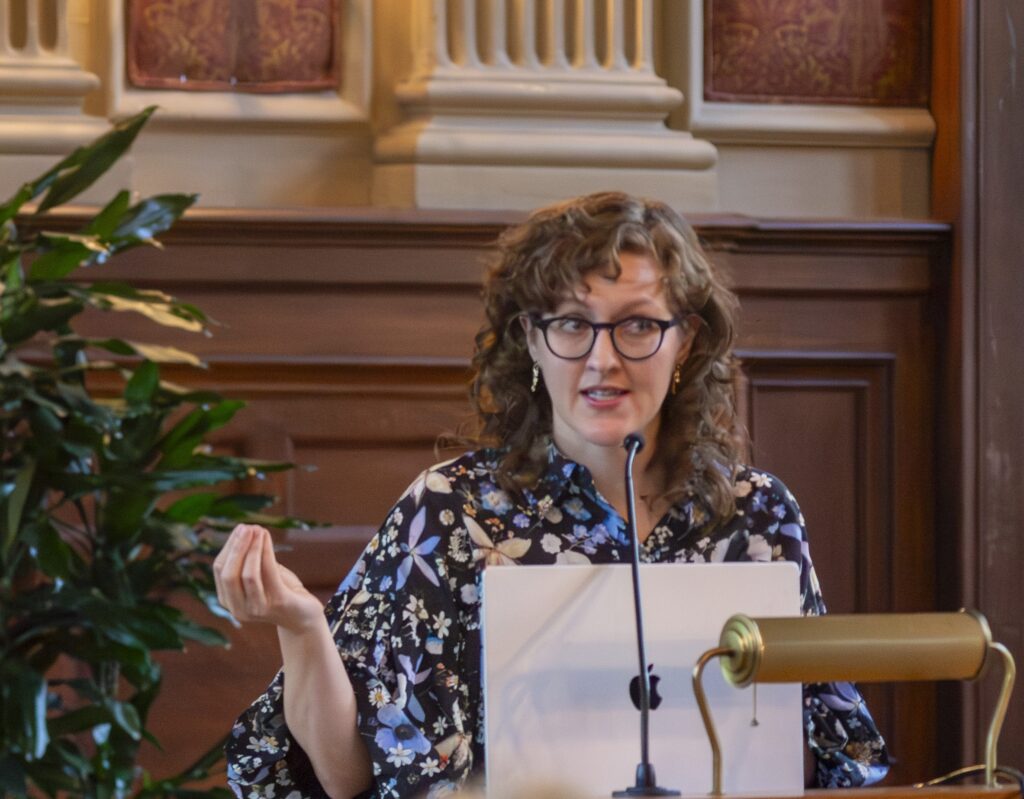
“With AI, everything is new,” says Alison Brockhouse, the ISP’s program manager of learning innovation. “We have no idea what the long-term impacts of it will be for students, teachers or school systems. At the same time, people are already using it. We’re meeting our partners where they are. It’s our responsibility to also be in this space with them.”
Sharing space with educators one problem at a time
Each academic year, more than 5,000 educators participate in one or more ISP programs, reaching 189,000+ PreK-12 learners in 346+ private and public schools across the St. Louis region.
A hallmark of the ISP’s approach to partnership is the collaborative nature of the work, a human-centered design rooted in a recognition that each challenge is extraordinary and unique to each situation and learning community. The experts are professionals in those communities who are doing the daily work of educating children. As a result, each new ISP collaboration begins with listening to these experts first. What do they want to do? What problem are they trying to solve?
“AI represents both challenge and opportunity,” adds Brockhouse. “With all of our other efforts with the ISP, we have things to attach our work to: data-driven goals, coaching frameworks, standards, and the latest research.
With AI, everything is untested and unproven, but that does not change the essential part of the work. We want to foster rigorous, joyful, and thriving classrooms and to give teachers what they need to be masters of their craft.”
Alison Brockhouse, ISP program manager of learning innovation
The ISP’s contributions to the accelerated conversations about AI in education are featured in Authentic Intelligence: Building STEM Classrooms of Belonging in the Age of AI, a report released September 30, 2026 by Beyond100K, a nonprofit organization that unites leading STEM organizations to co-develop and implement solutions that will end the STEM teacher shortage by 2043.
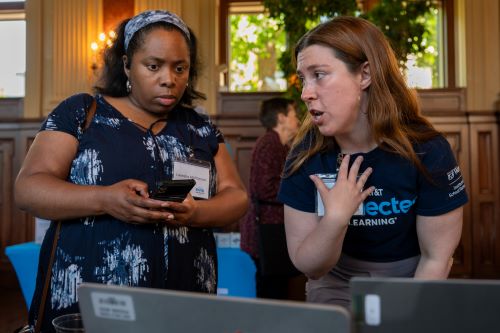
The spotlight, “Starting with the Problem: Building Educator Agency for AI,” highlights a year-long AT&T Digital Navigation Program developed and implemented by the ISP during the 2025-2026 academic year to provide 95 St. Louis-area STEM educators with foundational knowledge and confidence with technology, as well as an opportunity to work one-on-one with mentors to identify a problem of practice and develop a technology-based solution. The ISP’s approach to this professional learning kept the purpose, not the tools, top-of-mind.
“We’re helping teachers and districts approach new tools, including AI, with confidence, purpose, and agency, beginning with the problem, not the platform,” says ISP Associate Director Rachel Ruggirello. “What problems are educators and district leaders trying to solve, and how can we empower them to use AI in service of those needs?”
With educator input, the digital navigation program is evolving into an AI-focused model for teams of teachers and district leaders to develop and test collaborative projects based on a wide range of identified problems.
Leading conversations, including educators
The ISP’s commitment to keeping educators at the table for any and all conversations about AI and K-12 education has proven a high-value asset that stakeholders appreciate and need.
As a result, the ISP joins a number of critical AI-focused initiatives centered around doing what it does best with educators: asking questions, identifying problems of practice, proposing and testing solutions, collecting data, and then using that data to determine next steps. It’s all part of the ISP’s Plan-Do-Study-Act (PDSA) approach to problem-solving that gives educators and researchers alike dedicated space to explore problems of practice in a deliberate, focused way.
Brockhouse believes that the PDSA framework applies just as effectively for testing what works with AI and what doesn’t.
“There won’t be one thing that works for everyone, even with AI. Any time we’re making changes or trying to solve a problem, we can still be deliberate,” she says.
Brockhouse and Ruggirello are among other experts on a WashU team selected to participate in the FINDERS FOUNDRY program, an investment by the U.S. National Science Foundation Directorate for Technology, Innovation, and Partnerships (TIP), aiming to bring interdisciplinary K-12 teams together across formal and informal learning spaces to develop solutions to some of education’s most persistent and pressing challenges.
The WashU team is focusing on supporting teachers to plan lessons that connect ideas across different school subjects. With input from students, teachers, school leaders, and families from three St. Louis-area school districts) Lindbergh, Maplewood-Richmond Heights, and University City, the team will create AI-supported planning tools that build teacher capacity, save time, and support inquiry-based learning.
“By making planning easier for teachers, we hope this project will give students deeper, more connected learning experiences,” Ruggirello says.
The ISP also plays a central role in a groundbreaking, interdisciplinary initiative focused on the safe, developmentally appropriate integration of AI in K-12 and higher education.
Made possible with a Spark Grant and co-led by Ruggirello, WashU Professor of Political Science and Vice Provost of Innovation Betsy Sinclair, and WashU Professor and Vice Provost for Artificial Intelligence Nathan Jacobs, the Initiative unites a cross-disciplinary team of faculty, technologists, and K-12 educators to co-design AI-related instructional tools grounded in the learning sciences.
The ISP leads the effort to work with a cohort of seven K-12 educators from diverse school contexts to generate practice-based insights into how AI integration shapes student learning, engagement, and well-being.
“By grounding this work in educators’ perspectives and experiences, we’re positioned to develop a cohesive, scalable framework for AI integration that is both ethically sound and genuinely useful in real classrooms, not just in theory,” says Brockhouse.
The ISP, in partnership with Edthena, is also among research teams from the University of Michigan, Harvard University, and Vanderbilt University, to be awarded grants by Research Partnership for Professional Learning (RPPL) to research how AI can strengthen teacher professional learning. This project, led by PI Maia Elkana, will explore how AI can enhance the efficiency, reach, and quality of instructional coaching while preserving human expertise and teacher agency.
An Open Window
Despite the fast-moving nature of AI and the uncertainty about impacts large and small, Brockhouse believes the conversations are opening an exciting window.
“What’s exciting about this moment is that it’s an opportunity to revisit what’s fundamental about education,” she says. “Students, parents and educators have very legitimate concerns about AI, and these are driving some big conversations about why we go to school, how children actually learn, and the value of certain types of knowledge and skills.The conversations help us focus on all the things that AI can’t do, too, like hands-on science and field trips, and taking kids out in nature. I think there’s a lot of good stuff that could rise to the surface that will benefit education in the long run. The window is open.”