What’s the most effective way to understand what learners need to thrive?
As they go about tackling big challenges in education– everything from improving STEM learning to supporting students with chronic disease, to exploring the factors that influence school mobility– WashU researchers know it’s best to bring along others who are just as invested.
By deeply engaging with teachers, districts, and community organizations that share a desire to improve a wide range of conditions and outcomes for students, they can bridge research and practice in ways that are mutually beneficial. These collaborations are known formally as research-practice partnerships (RPPs).
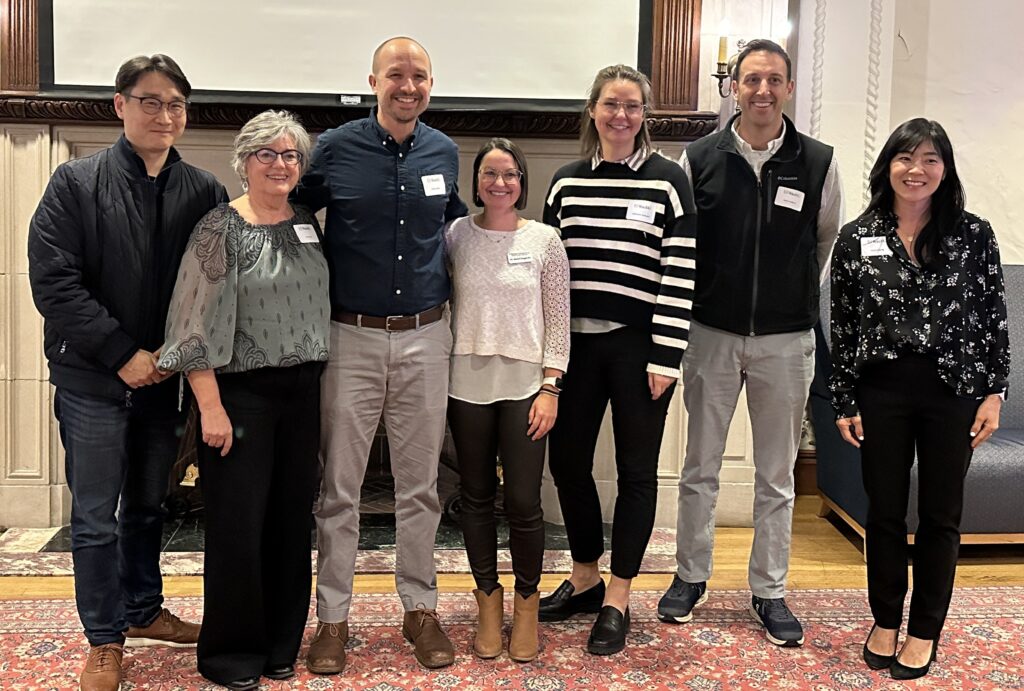
Ten WashU-connected RPPs were featured at the St. Louis Education Research Practice Partnership (RPP) Showcase, an event held December 4 in the Women’s Building Formal Lounge on the Danforth Campus. Co-sponsored by the Center for Education Research, Practice and Policy Partnership (CERP³) and the Institute for School Partnership (ISP), the showcase opened with guest speaker Paula Arce-Trigatti, the inaugural director of the National Network of Education Research-Practice Partnerships (NNERPP).
“What better way to elevate the research-practice partnerships we have at the University that are focused on education than to open with support from the director of NNERPP and the ISP, a WashU team deeply engaged in RPP work?” said CERP³ Research Manager Catherine Schwarz.
Schwarz coordinates efforts of the CERP³ team, which has leaders from WashU’s Brown School, School of Medicine, Arts & Sciences, and the ISP.
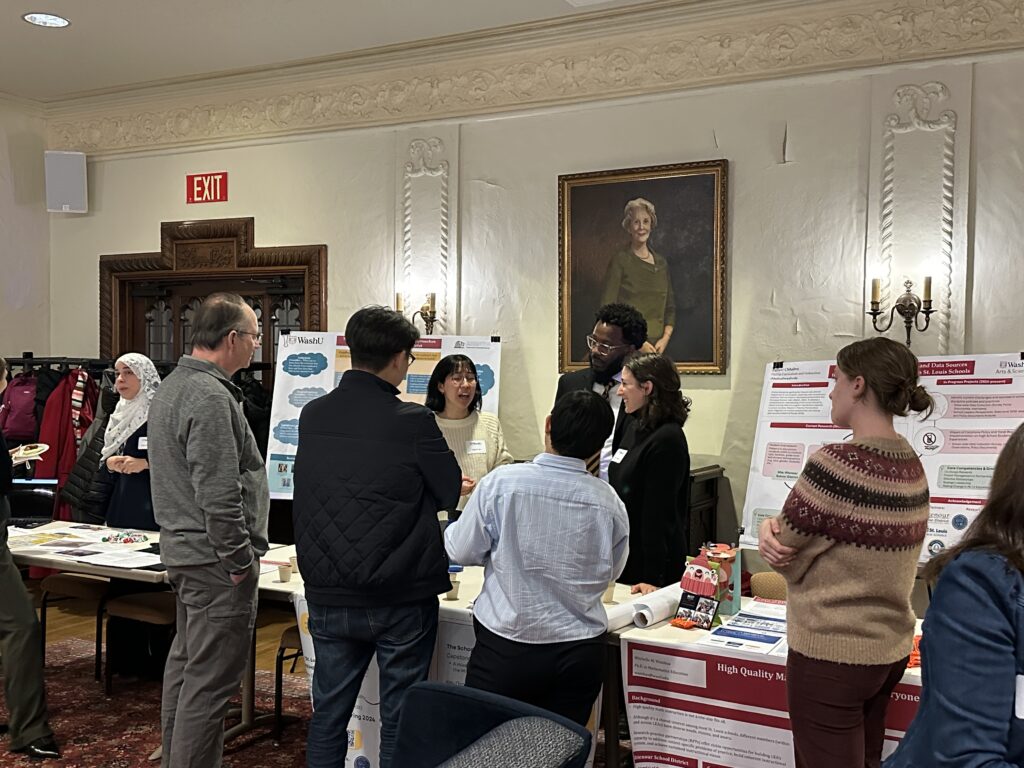
“The diversity of the projects and all the artifact tables in the room was really exciting,” added Schwarz. “We had people representing early childhood, science instruction, college access, and student mental health, as well as different models for engaging with educators. These included teacher-researcher partnerships, cross-district policy partnerships, post-doctoral students placed in school districts, and individual researcher relationships with partners.”
ISP Associate Director Rachel Ruggirello, who welcomed participants to the event by sharing the ISP’s work in the RPP space, agreed.
“The ISP’s work was represented by four tables at the event, so this was naturally a great opportunity to elevate this, but it also allowed us to convene others who are meaningfully contributing to improving student outcomes and societal well-being through education research-practice partnerships in our region,” said Ruggirello. “RPPs share common features and approaches to their work, but each partnership has a unique culture and way of operating. By exploring the various ways in which these collaborations thrive, we hope that attendees left with a deeper understanding and renewed enthusiasm for RPP work.”
Learn more about RPPs & topics:
(WashU’s ISP, Arts & Sciences, and School District of University City)
(WashU’s ISP, Arts & Sciences, Engineering, Regional K-12 schools)
(WashU’s Brown School, Urban Strategies)
- Early Childhood RPP: Kindergarten Readiness and Teacher Leadership
(WashU’s ISP, Hazelwood School District)
- Leading Change Together: A PLC’s Journey with a New Math Curriculum
(WashU’s ISP, Ritenour High School)
- Presentation: Math Curriculum Implementation Presentation Mitchelle Wambua math314 meeting 20250207
- Poster: Wambua 2025 Navigating Researcher and Practitioner Roles in an RPP Focussed on Implementing a New Mathematics Curriculum Poster PMENA .pdf
(WashU’s Arts & Sciences, KIPP High School)
- Implementing School-Based Suicide Prevention in Missouri
(ASPEN Health, Inc., Missouri School Districts)
(WashU’s Arts & Sciences, School District of University City)
(WashU’s Brown School/School District of University City)
- St. Louis Translational Fellows in Education Program
(WashU’s Arts & Sciences and ISP/ Policy Research in Missouri Education (PRiME) Center, and the St. Louis Research Practice Collaborative)
(WashU’s Brown School, Arts & Sciences, St. Louis Community Foundation)